

![Ernest Kador [AKA Ernie K-Doe],](https://live.staticflickr.com/65535/54890813115_17786cd5d2.jpg)


New Orleans @ 45 RPM: 1950-1980
Based partly on the successful use of vinyl recordings by the Army during WWII, in the later 1940s two prospective vinyl replacements for 78 rpm discs were introduced. Made from shellac, 78s were heavy, fragile, and produced a lot of surface noise. Compared to 78s, the new vinyl records were lighter, cheaper, more durable, and sounded better.
The question was, which new vinyl format would prevail, Columbia's 10/12", 33-1/3 rpm LPs, or RCA Victor's 7", 45 rpm discs? As it happened, both formats were hugely successful.
Several factors contributed in particular to the 45's success. Cheap and portable, it was an immediate hit with the emerging youth market. The combination of "teen agers" and 45s propelled a succession of new pop genres (R&B, Rock-n-Roll, Soul) and an explosion of new record labels, first at the national level, then later local and regional.
Another factor in the 45's ascendance was the jukebox, which had a symbiotic relationship with the recording industry. (For example, consider that a figure as influential as Cosimo Matassa began his recording career as part of a jukebox operation owned in part by his father.) The 45's light weight and durability--and the large doughnut hole--made it particularly well-adapted to the kind of mechanical manipulation required by a jukebox. As the jukebox grew in popularity through the 1950s and beyond, so did the 45. The jukebox market gave smaller record companies another powerful incentive to release 7" 45-rpm singles.
DJs appreciated the 45's durability and ease of handling. The 45 also gave DJs the power to turn B-sides into unexpected hits, as in the case of Fats Domino's "My Blue Heaven" (which was the B-side to "I'm In Love Again") and many, many others.
Until the 1960s, when rock star mojo carried the LP to supremacy, 45s ruled genres like R&B and rock.
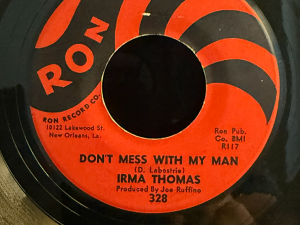
In New Orleans, the arrival of the 45 roughly coincided with the emergence of the city's unique variety of R&B. During the 1950s, the New Orleans recording industry was dominated by out-of-town companies like Imperial, Aladdin, Savoy, and Specialty. However, with the success of home-grown companies like Minit, Ric, Ron, Instant and AFO, by the early 1960s, the out-of-town dominance ended. To get a sense of the range of labels, see our list of New Orleans Record Labels 1950-1980.
In 1957, following a string of hits recorded in New Orleans, Los Angeles-based Specialty Records opened a local branch office; its LA-based competitor, Imperial Records, also had a NOLA office. Specialty hired a young jazz musician named Harold Battiste to manage its operations. A few years later, Battiste founded the highly influential AFO (All for One) Records, New Orleans' first black-owned label.
Rosemont Records, founded by Alfred Elijah Taylor, was one of New Orleans’ first Black recording studios and one of its most prolific and long-lived labels. Rosemont released everything from 1960s gospel artists to some of the city's first hip hop in the 1980s.
Getting and keeping national distribution deals was a challenge for many local record labels. Enter Cosimo Matassa's Dover Records in 1965, a distributor of dozens of local and regional record labels. Dover’s mission was to provide a way for the music of New Orleans and the Gulf Coast to be heard by a wider audience.
The failure of Cosimo's recording businesses (he also owned the Jazz City recording studio and a vinyl pressing plant in Jefferson Parish), due in part to inability to keep up with the demand for hit records, also ended his national distribution operations. This was a disaster for local record labels, and many did not survive.
Even though there were fewer labels in the 1970s, acts like the Meters, Doctor John, and Allen Toussaint still sold a ton of 45s. Nationwide, the peak year for sales of 7" vinyl 45s came in 1974, with about 200 million units sold. But its demise had already begun with new formats like 8-track and cassette tapes and the 12" vinyl single. And a decade or so of "album-oriented" radio had amply proven that you could have hit songs without releasing them individually.
Forty-five years ago, as the 45's decline was accelerating, something happened that would ensure the memory of all those New Orleans 45s would live on: in 1980, WWOZ was born!
REFERNCES
Jim Dawson and Steve Propes, 45 RPM: The History, Heroes & Villains of Pop Music Revolution, Backbeat Books, 2003.
David Brown, "How the 45 RPM Single Changed Music Forever: Charting the rise, fall, resurrection and legacy of the beloved vinyl format, which helped bring rock & roll to the masses," Rolling Stone, March 2019.
"May the 45 Be With You," Rock-ola.com blog, May 4, 2025
Jeff Hannusch, "Connie LaRocca and Frisco Records," OffBeat Magazine, March 1999.
Jason Berry, Jonothan Foose, and Tad Jones, Up from the Cradle of Jazz: New Orleans Music Since World War II, University of Louisiana at Lafayette Press, 2009.
A Closer Walk: New Orleans Music History, Block by Block entries on Specialty Records Branch Office, Jazz City Studio, and Rosemont Records.
SUPPORT WWOZ